What the World Cup’s tracking tech can teach service businesses about marketing

Football’s gone high-tech. Players at this year’s World Cup are wearing snug, GPS-loaded vests under their jerseys. They’ve been mistaken online for sports bras. But they’re actually performance trackers that sit between the shoulder blades, right at the athlete’s centre of mass. The official match ball has its own sensor now too, reporting the force and timing of every touch the moment it happens. Between the two, teams have more real-time data on player and ball movement than at any World Cup before it.
It’s a good story. But the detail that matters for anyone running a service business isn’t the tech itself – it’s where the sensor sits.
It’s not the tracker, it’s the placement
The vest’s pod isn’t strapped to the wrist, because a wristwatch bounces around during a sprint and gives you noisy, unreliable data. It sits at the centre of mass instead – the one spot on the body that stays stable no matter how hard the player’s moving, so the numbers coming off it are actually trustworthy.
Most service businesses are tracking their marketing from the wrist.
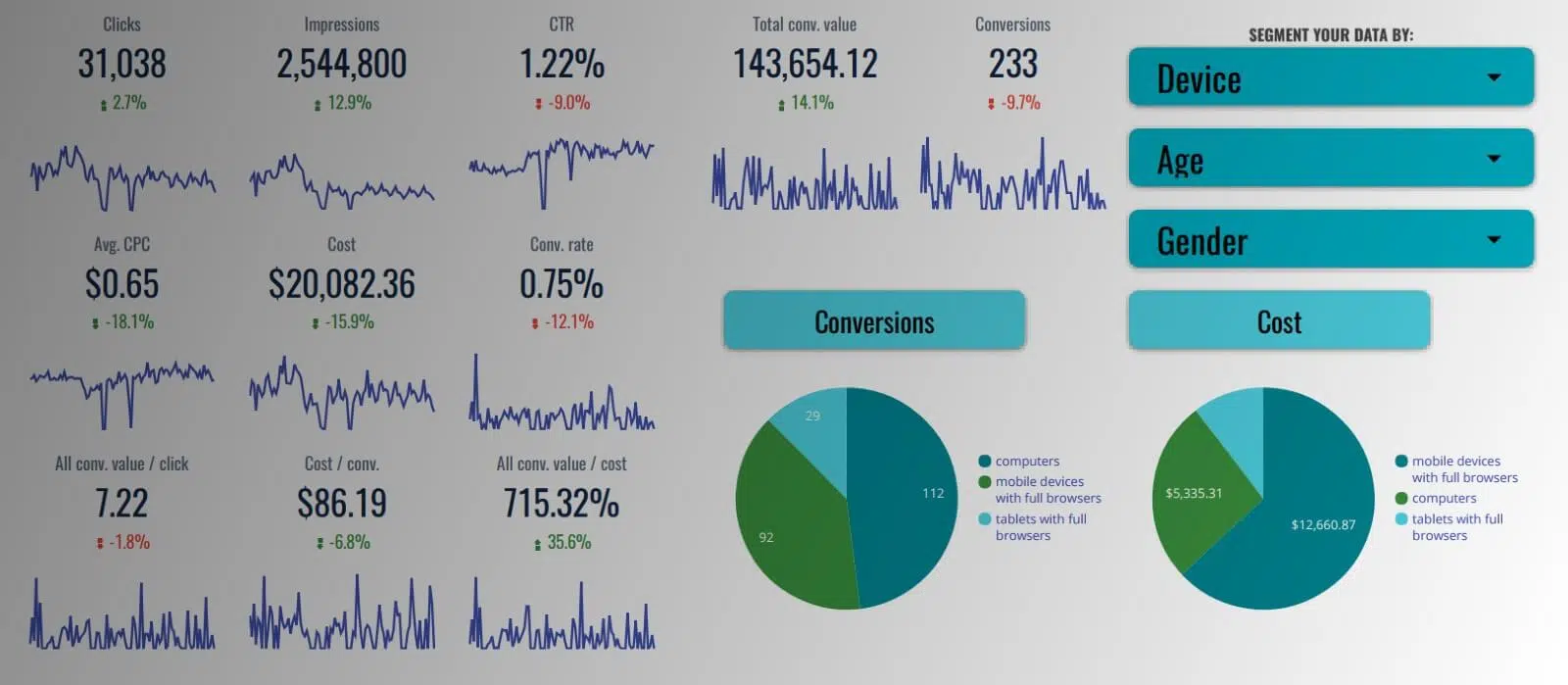
They’ve got a dashboard. Google Ads is telling them clicks and cost per click. GA4 is telling them sessions and bounce rate. Maybe there’s a lead count from a contact form. All of that is real data – it’s just not sitting anywhere near the centre of mass of the business, which is revenue. It tells you what happened on the way in the door, and nothing at all about what happened after.
The gap most businesses never close
Here’s the pattern we see constantly with trades, renovation businesses, clinics, law firms – anyone running paid search or SEO to generate enquiries rather than sell off a shelf.
Someone clicks a Google Ad. They fill in a form. That lead lands in an inbox or a spreadsheet. From there, it goes cold as a marketing data point – even though the sales team keeps working it. Maybe it turns into a $4,000 job. Maybe it turns into an $80,000 one. Maybe it goes nowhere. None of that ever makes its way back to the campaign, the keyword, or the ad group that produced it.
So the business ends up optimising for the thing it can measure – cost per lead – instead of the thing it actually wants, which is cost per closed, high-value lead. Those may not be the same. A keyword that produces a flood of cheap enquiries can be a poor performer in the account once you account for close rate and job value. And you’d never know, because the data needed to see that never gets tracked past the point of the form submission.
That’s the wrist. Plenty of readings, none of them close to where the value actually is.
What centre-of-mass tracking looks like
We’re currently rolling this out for one of our clients, and the mechanics are pretty simple even though most businesses never get around to setting them up.
Google Ads and organic leads flow straight into the CRM. Every enquiry carries its source with it — which campaign, which keyword, which landing page, whether it came from paid or organic search – instead of landing as a nameless entry in an inbox.
The CRM tracks the lead all the way to outcome. Did it close? What was the job worth? That data already exists inside most CRMs; it’s just sitting disconnected from the marketing platform that generated the lead in the first place.
The close and the value feed back into Google Ads. Once you can tell Google which conversions were actually valuable – not just which ones happened – you can optimise the campaign toward more of those. Google’s bidding algorithms are very good at finding more of whatever you tell them counts. Most accounts are telling them “count the form fill.” Few are telling them “count the $40,000 job,” because most businesses have never connected the dots to know which leads those were.
The result isn’t a better-looking dashboard. It’s a different kind of decision. Instead of “which campaign got the most leads,” the question becomes “which campaign got us the leads that actually made us money” – and those are frequently not the same answer.
Meaningful metrics, not just more of them
None of this requires more tracking. Most businesses are already collecting plenty of data – it’s just scattered wrist-level, disconnected from the outcome that matters. The fix isn’t a bigger dashboard or another tool bolted on top. It’s connecting the systems that already exist – ad platform, website, CRM – so a lead’s story doesn’t end the moment it lands in an inbox.
That’s the real difference between meaningful metrics and metrics that just bounce around on your wrist: one set tells you what happened, the other tells you what to do next.
If your Google Ads and SEO reporting stops at leads or enquiries and never quite makes it to revenue, that’s usually not a tracking problem you’re missing – it’s a connection you haven’t made yet between the platforms you’re already using. It’s a straightforward fix, and it changes what “performing well” actually means for the campaign.
Digital Autopilot works with service businesses across Australia on Google Ads, SEO and the CRM integrations that connect the two to actual revenue. Get in touch if you want to know what your marketing looks like once it’s tracked all the way through.
Note: Image above is an AI generated image of a player wearing GPS vest. Credits: Sportscape