
Overview
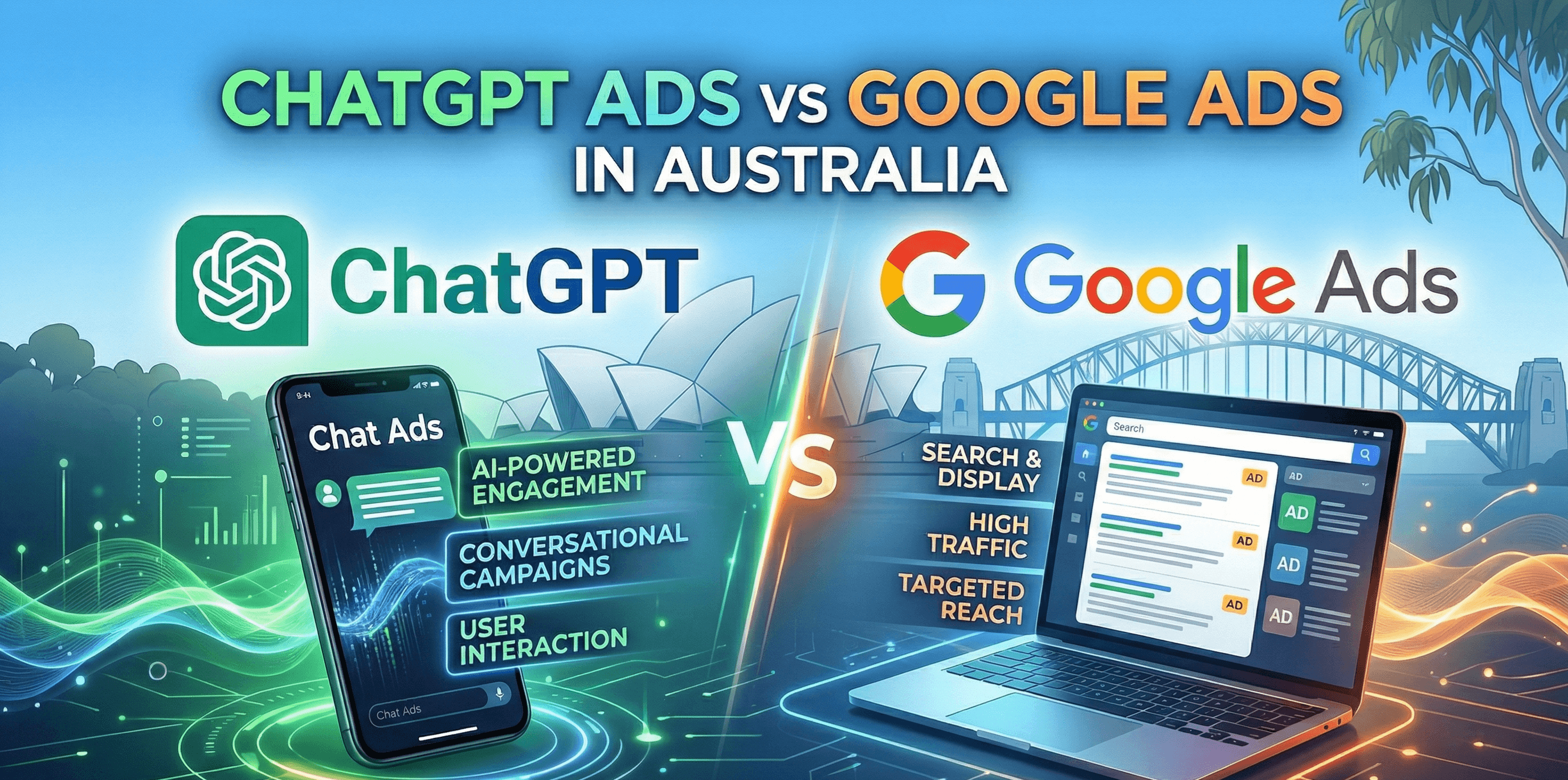
On March 26, 2026, OpenAI confirmed that ads are expanding into Australia, New Zealand, and Canada in the coming weeks. This follows a US pilot that launched on February 9, 2026 and has already crossed $100 million in annualised revenue with over 600 advertisers on board.
For Australian businesses running Google Ads, the natural question is: should I care? And the honest answer is: yes, but not in the way you might think. ChatGPT ads are not Google Ads. The platform, the pricing, the targeting, the measurement, and the user behaviour are all different. Right now, this is an early-stage pilot, not a mature ad platform. But it is real, it is coming here, and it is worth understanding what it means before it lands. As an aside, my business partner replied when he heard the news, “That means prob only weeks or a few months away from everyone else” – I don’t think it will be that soon, but who knows.
In this post I am going to try and break down what we know so far, how ChatGPT ads compare to Google Ads, what the early US data is telling us, and what Australian businesses should actually do about it.
Table of Contents
2. What ChatGPT Ads Look Like Right Now
3. Who Sees the Ads (and Who Doesn’t)
8. What Should Australian Businesses Do Right Now?
Why ChatGPT Is Running Ads
Sam Altman, CEO of OpenAI, called ads “a last resort” back in 2024. That wasn’t that long ago. And yet here we are in 2026, and ads are live in the US and rolling out to other regions such Canada, Australia and New Zealand, to start with.
The reality is that running AI infrastructure at the scale OpenAI operates costs an enormous amount of money. Subscriptions alone aren’t covering it. If this is their “last resort,” it does make you wonder about any other commitments they’ve made about their mission and brand. But from a business standpoint, it was always going to happen. The pressure from investors to show returns is real, and advertising is the most obvious lever they have.
It kind of reminds me of Google’s past motto “don’t do evil.” Look where that ended up – I’m not suggesting that Google is evil per se, but they’ve done a lot of things that may have harmed people along the way, given their size, despite all the amazing benefits and conveniences they offer. Google became so dependent on ad revenue that their entire business model revolves around it. It seems ChatGPT has gone down the same road, or at the very least, they’re adapting to the commercial reality that every platform eventually faces.
I’ve long held the view that Google is very well positioned to dominate the AI market. For years they’ve had Chrome, Google Search, Ads, Google Maps, YouTube, and a mountain of user data behind all of it. The pressure for ChatGPT to try and catch up to Google and eat into their market share was always going to push them toward monetisation. Ads were the obvious answer.
What ChatGPT Ads Look Like Right Now
The ads appear at the bottom of ChatGPT’s responses. They are labelled as “Sponsored” and visually separated from the organic answer. OpenAI has been clear that ads do not influence the responses ChatGPT gives.
Digital marketer Glenn Gabe, shared on X how the ads are showing on mobile and confirmed it isn’t showing on Plus accounts.
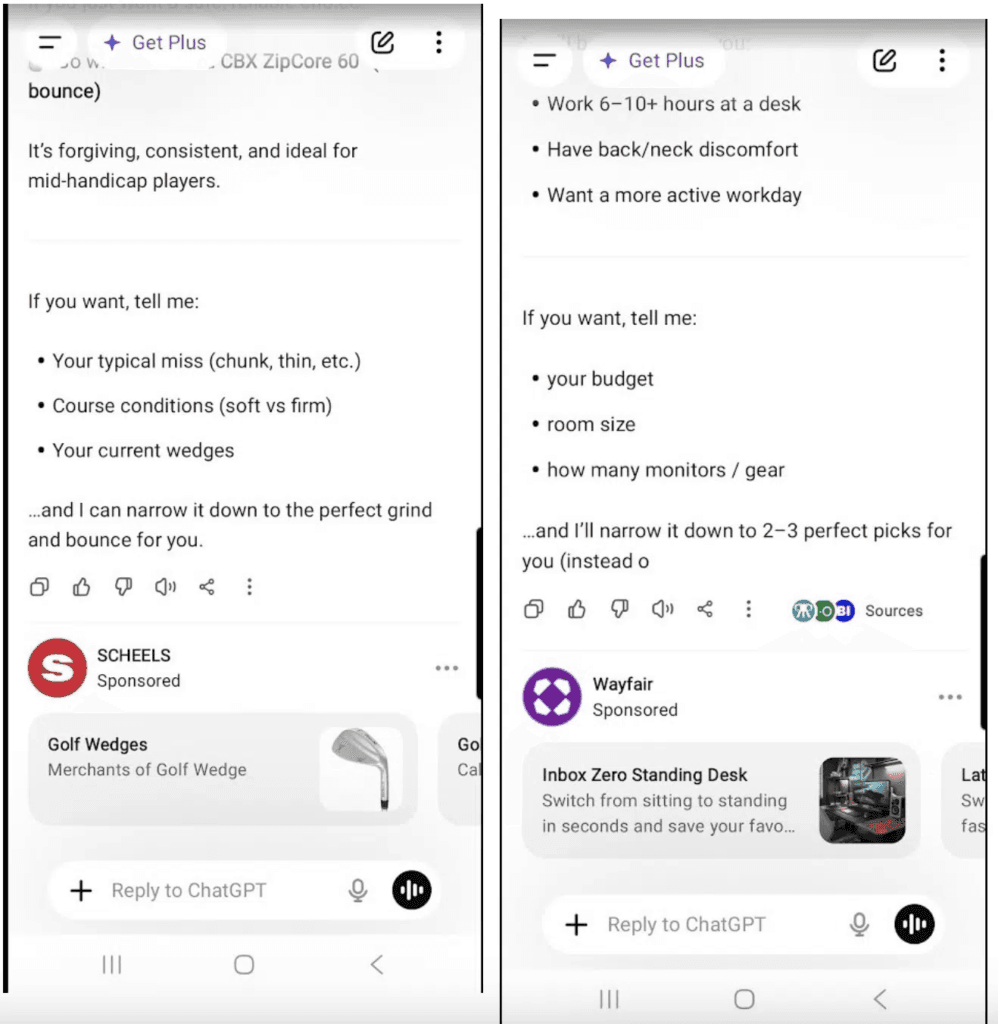
Based on early reports from US users, the ads are broad. They cover a whole range of industries: pet food, hotel bookings, vacations, streaming services, finance, productivity software, coding tools, sporting tickets. Travel-related questions seem to trigger the most ads.
One thing that’s already surfacing is that when you search for a specific brand, competitors are appearing as sponsored results alongside it. That’s going to frustrate some of the bigger brands. It’s the same tension that exists in Google Ads when a competitor bids on your brand name, but in a conversational context it could feel even more jarring.
Who Sees the Ads (and Who Doesn’t)
The rollout is limited to logged-in adult users on ChatGPT’s Free and Go tiers. If you’re on a paid plan (Plus, Pro, Business, Enterprise, or Education), you won’t see ads.
This seems to create a clear incentive to upgrade if you want an ad-free experience, and it protects the experience for their highest-paying customers. It will be interesting to see whether the presence of ads pushes some free users to pay for the service. My take is that most people love getting things for free, even if it comes with the occasional ad. They’re used to it from Google anyway. Why would it be different with ChatGPT?
Why Australia?
OpenAI’s Australian head of communications, Chloe Browne, told Mumbrella that usage in Australia has more than doubled in the past 12 months. They’ve also established a local Australian team, which makes it a natural place to expand testing.
Australia is a small enough market to test in without the risk of going too big too fast, but with high enough usage and a mature digital advertising market to generate meaningful data. It’s a sensible choice for a pilot. New Zealand and Canada are also in the first wave of expansion.
What the Numbers Tell Us From the US So Far
The US pilot launched on February 9, 2026. Within six weeks, OpenAI’s ad business crossed $100 million in annualised revenue. That number sounds impressive, and it is, but context matters.
That revenue came from fewer than 20% of eligible users actually being shown ads on any given day. Around 85% of Free and Go users are eligible to see them but most aren’t seeing them yet. This is with only around 600 advertisers on the platform, so right now it’s still limited to the bigger players.
Self-serve advertiser access is expected to launch in April in the US. That’s when things could get more interesting for smaller businesses.
From a quality perspective, OpenAI says fewer than 7% of ads are rated by users as low relevance. The company says it is actively working to improve that number. They also say there has been no impact on consumer trust metrics and low dismissal rates.
In Google Analytics, the data we’re seeing across our clients is that around 1% of traffic is currently coming from AI chat engines. That may rise as user behaviour changes, but for now it’s a small number.
ChatGPT Ads vs Google Ads
This is where it will get interesting for marketers. These two platforms work very differently – at least from what we know so far about the new player.
Google Ads is query-led, which means someone types a specific search, your ad matches that keyword, and you bid in an auction based on relevance, quality, and price. You pay per click. You get detailed data on conversions, attribution, device, location, time of day, and dozens of other variables. It’s a mature auction platform with years of advertiser tooling behind it – I have been in it practically every work day for nearly 15 years.
ChatGPT ads are conversation-led, which means instead of matching a typed search query, the ad opportunity appears while someone is in a back-and-forth conversation. They might be researching, comparing options, or asking for recommendations. OpenAI says it chooses which ad to show by matching advertiser submissions to the conversation topic, and in some cases to the user’s past chats, memories, and prior ad interactions if personalisation is enabled.
The pricing model is different too, at least when it comes to Google search. ChatGPT is charging on a cost-per-thousand-views (CPM) basis rather than cost-per-click like Google Ads. Reports suggest the CPM is around $60, which is steep by digital advertising standards. It’s lower for both Meta and the Google display network so far. ChatGPT’s pricing is closer to what brands pay for premium television spots – which kind of makes sense since they’re so far targeting just the top-tier brands.
The privacy walls are also tighter. Advertisers do not get access to individual chats, chat history, memories, or personal details. They only receive aggregate, non-identifying performance data like views and clicks. Ads are excluded from sensitive or regulated contexts including health, mental health, politics, and other high-risk categories.
On the measurement side, there’s a gap. Google Ads has conversion tracking, offline conversion imports, enhanced conversions, server-side tracking, modelled conversions, and a full attribution stack. ChatGPT ads, at least publicly, offer aggregate impressions and clicks. That’s it. No conversion pixels, no ROAS calculation, no attribution modelling that we know of. For businesses that rely on performance marketing metrics, It’s a big leap of faith to rely on aggregate data.
On targeting, Google gives advertisers virtually full control over keywords (oh, the good ole days when exact match meant exactly that), audiences, geography, devices, schedules, bids, and conversion goals. ChatGPT’s advertiser-side controls haven’t been publicly documented yet. There’s no public information showing whether advertisers can target by keyword themes, audience segments, geography, exclusions, frequency, or conversion goals the way they can in Google Ads.
On how ChatGPT ad traffic will appear in GA4, OpenAI hasn’t published any documentation explaining a standard source/medium format, auto-tagging equivalent, or UTM conventions. Practically, that means traffic will likely land as a referral or direct-like source depending on implementation. But there’s no official announcement yet.
In a nutshell, Google captures declared intent whilst ChatGPT seems to capture evolving intent. On Google, the person often already knows roughly what they want. In ChatGPT, they may still be working out the problem, comparing options, or asking for recommendations, which could become a powerful advertising context over time, but today it’s still early.
What We Don’t Know Yet
There’s a lot that hasn’t been publicly documented.
How the billing model actually works for advertisers. Is it a flat CPM? Is there an auction? What are the minimums? We don’t have public answers to these questions yet.
What the advertiser portal looks like. What controls will marketing teams have over targeting, messaging, budgets, and all the other things we’re used to in Google Ads, Meta, and other platforms? We don’t know.
Whether ads will stay positioned below the chat results or whether OpenAI will find other placements to drive more views. If they’re getting paid per thousand views, there’s an incentive to increase view counts.
How conversion tracking will develop. Will OpenAI offer anything comparable to Google’s measurement stack, or will this remain a brand awareness play?
Whether this will be a bottom-of-funnel bridge to sales and leads, or primarily a top-of-funnel brand awareness channel. Early signs point toward the latter, but things are moving fast.
What Should Australian Businesses Do Right Now?
If you’re running a small to medium business spending $5,000-$15,000 a month on Google Ads, ChatGPT ads are not something to think about right now. The pricing is enterprise-level, the measurement is limited, and the self-serve tools aren’t available in Australia yet.
What you should do is pay attention, pay attention and stay up to date with any updates. Watch what happens when the Australian pilot goes live. Look at the real experiences that businesses report. See what sort of ROI early advertisers are getting.
Make sure your Google Analytics is set up properly so you can track any traffic that does come through from ChatGPT, whether organic or paid. Keep an eye on the source/medium reports in GA4 for any ChatGPT referral traffic.
And keep doing what works. Google Ads is still the dominant platform for capturing high-intent search traffic in Australia. That hasn’t changed. ChatGPT ads may become an additional channel over time, but right now they’re not a replacement for a well-run Google Ads campaign.
To try and predict what this looks like in six or twelve months would be foolish. The best thing you can do is stay informed, keep watching, and be ready to test when the platform matures and the economics make sense for your business.
My Take on All of This
The marketer in me says this was inevitable. Whether it was OpenAI or another AI platform, ads were always coming. Google has begun testing ads in its AI features already. The question is just who can do it better. As marketers, we need to test and see what gets results. If it works, businesses will flock to it. That’s a free market.
I’ll admit I was a bit naive thinking that maybe OpenAI had figured out a different model by charging subscriptions and keeping the experience clean. But once you introduce ads, the lines start to blur. OpenAI has said their answers will remain independent and unbiased, that conversations stay private, and that users retain control over their experience. Sound familiar? We’ve heard similar assurances from Google over the years, and the question of whether Google Ads influence SEO results is still asked regularly – here’s my answer to that question.
The conversations people have in ChatGPT are not, at this stage, being shared with advertisers. That’s worth noting, but it will remain a concern as the platform evolves.
For us marketers and advertisers, the time is here. We need to be alert, on top of what’s happening, and watching what sort of ROI people are actually getting. And we need to do what we always do: follow the data, test what works, and make decisions based on real results rather than hype.
FAQs
Will ChatGPT ads appear for all users in Australia?
No. Ads will only appear for logged-in adult users on the Free and Go tiers. If you’re on a Plus, Pro, Business, Enterprise, or Education plan, you won’t see ads. (Source)
When exactly will ChatGPT ads go live in Australia?
OpenAI said the expansion will happen “in the coming weeks” following the March 26, 2026 announcement. No specific date has been confirmed.
Do ChatGPT ads influence the answers ChatGPT gives?
OpenAI says no. They state that answers are optimised based on what’s most helpful to the user, and ads are clearly labelled as sponsored and visually separated from the organic response. (Source)
How much do ChatGPT ads cost?
The pricing model is based on cost-per-thousand-views (CPM) rather than cost-per-click. Reports suggest a CPM of around $60, which is high compared to other digital ad platforms. There’s no public documentation yet on minimums, auction mechanics, or detailed billing.
Can small businesses advertise on ChatGPT?
Not yet in a practical sense. The US pilot has been limited to around 600 advertisers, mostly larger brands. Self-serve advertiser access is expected to launch in the US in April 2026. There’s no confirmed timeline for self-serve access in Australia.
How is ChatGPT ad targeting different from Google Ads?
Google Ads lets you target by keyword, audience, geography, device, schedule, and conversion goals. ChatGPT matches ads to the topic of the conversation, and optionally to the user’s past chats, memories, and prior ad interactions. The advertiser-side controls have not been publicly documented yet. (Source)
Will ChatGPT ad traffic show up in Google Analytics?
There’s no official documentation from OpenAI on how ChatGPT ad traffic will appear in GA4. It will likely appear as a referral or direct-like source depending on how the links are implemented, but there’s no confirmed source/medium format or auto-tagging system.
Should I shift my Google Ads budget to ChatGPT ads?
No. Google Ads remains the dominant platform for capturing high-intent search traffic in Australia. ChatGPT ads are still in a pilot phase with limited measurement, no conversion tracking comparable to Google’s, and pricing that is currently geared toward larger advertisers. Keep doing what works with Google Ads and monitor ChatGPT ads as the platform develops.
How much revenue has ChatGPT’s ad pilot generated so far?
The US pilot crossed $100 million in annualised revenue within six weeks of launching on February 9, 2026. This was generated from fewer than 20% of eligible users being shown ads daily, with around 600 advertisers on the platform.
What types of ads are appearing in ChatGPT?
Early reports from the US show ads across a wide range of industries including pet food, hotel bookings, vacations, streaming services, finance, productivity software, coding tools, and sporting tickets. Travel-related queries seem to trigger the most ads.
Is this going to replace Google Ads?
No. Google Ads has a mature auction platform, detailed attribution, established measurement tools, and massive scale. ChatGPT ads are a new, early-stage channel. They may become an additional part of a business’s marketing mix over time, but they are not a replacement for Google Ads today.
Are my ChatGPT conversations being shared with advertisers?
No. OpenAI says advertisers do not get access to individual chats, chat history, memories, or personal details. Advertisers receive only aggregate, non-identifying performance data such as views and clicks.