We Built an AI Tool That Audits Your Law Firm’s Website for Conversion in Under 60 Seconds

There’s a question we ask every law firm we work with, and almost none of them can answer it confidently.
Is your website actually built to convert visitors into enquiries?
Not just look professional. Not just rank on Google. But actively turn curious visitors into qualified leads who pick up the phone or fill in a form.
Most law firm websites aren’t doing that job. And the cost of that gap, in lost enquiries, wasted ad spend, and leads quietly going to a competitor, is bigger than most firms realise.
So we built something to change that.
What We Built
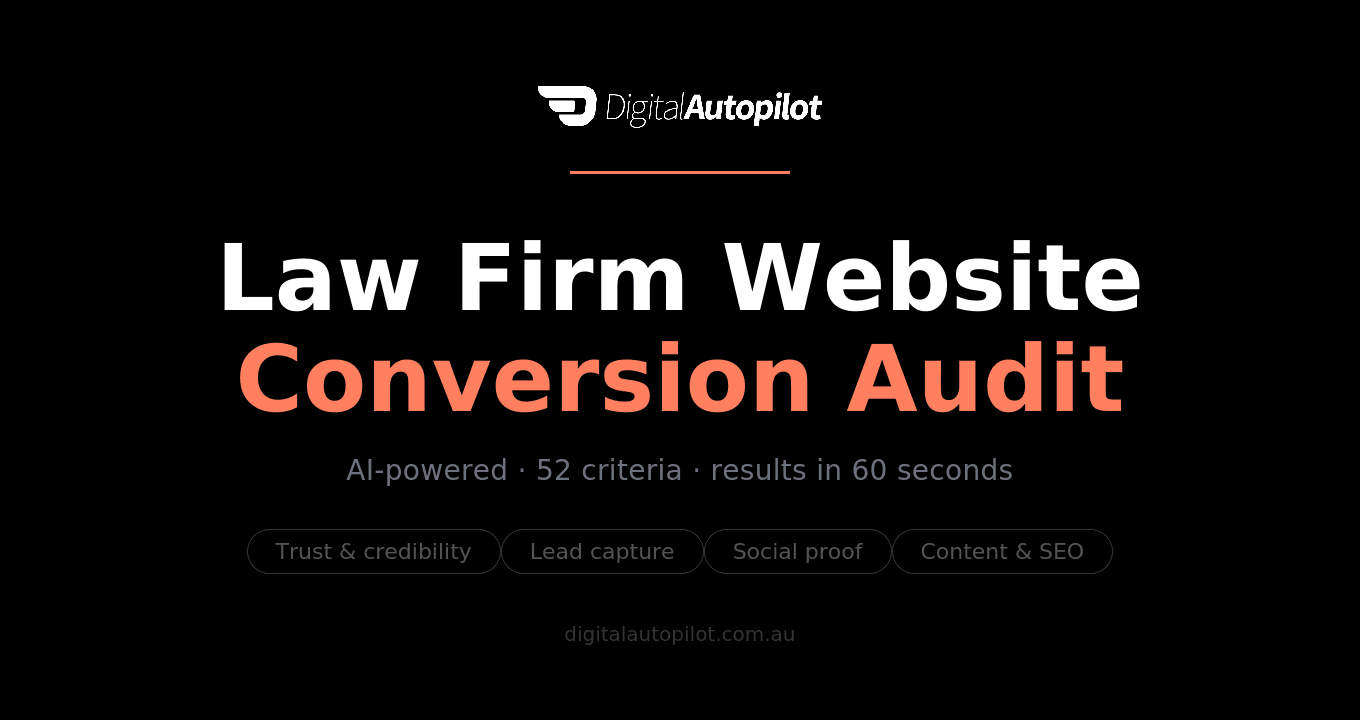
We’ve just released a tool that does something which used to take a skilled consultant several hours and cost thousands of dollars. It performs a comprehensive conversion rate optimisation audit of any law firm website in under 60 seconds.
You type in a URL. Our AI browses the website, reads the homepage, service pages, about page and contact page, then scores it across 52 conversion criteria we developed specifically for service-based businesses. Every item is rated from 1 to 5, weighted by its impact on lead generation, and organised into eight categories:
- Trust and credibility – Does the site make visitors feel safe enough to enquire?
- Homepage and value proposition – Is it immediately clear who you help and why you’re the right choice?
- Service pages – Do your practice area pages answer every question a prospect has before they contact you?
- Lead capture and CTAs – Are you making it easy and compelling to get in touch?
- Social proof and authority – Are you showing enough evidence that you deliver results?
- Contact and conversion experience – Is the enquiry process frictionless?
- Mobile and technical performance – Does the site work properly on the device most of your prospects are using?
- Content and thought leadership – Are you building the kind of authority that drives organic traffic and long-term trust?
The output is a scored, prioritised report that shows you exactly where your site is winning leads and where it’s losing them.
We recently ran the tool on LegalVision, one of Australia’s most prominent law firms. [Watch the full audit here] and [read our detailed breakdown here]. The findings were eye-opening, even for a firm of their scale.
How We Built It
We built this tool using Claude, Anthropic’s AI model, and if you’re curious about the technical side it’s worth a few minutes of your time, because it represents a genuine step forward in what AI-powered business tools can actually do.
The tool is a single React application that calls the Anthropic API directly from the browser. When you enter a URL, Claude browses the site using a built-in web search capability, reading each page much like a human analyst would. It then applies our 52-point framework, which we developed based on years of conversion optimisation work with professional service businesses. Each criterion carries a priority weighting (high, medium or low) that determines how much it influences the overall score.
Claude returns a structured response containing a score and a specific, evidence-based observation for every criterion. Not generic commentary. Actual observations about what it found, or didn’t find, on that specific site. Those results populate an interactive dashboard where you can review findings section by section, override any rating you disagree with, add your own notes, and pull up a Priority Issues report that ranks your biggest opportunities by impact.
The whole process takes 30 to 60 seconds.
Why the combination of AI and a structured framework matters
What makes this genuinely useful isn’t the speed on its own. It’s what happens when you combine AI capability with a well-built expert framework.
Without the framework, AI produces generic observations. It might notice that a site has testimonials, but it won’t know that testimonials with named clients, photos and specific outcomes convert far better than anonymous quotes. Or that a live Google review widget is more persuasive than self-curated testimonials because it’s independently verifiable.
Without AI, applying a 52-point framework across multiple pages takes hours. The expertise exists but applying it consistently and affordably to every client just isn’t practical at scale.
Put them together and you get something neither can produce alone: a rigorous, specific, expert-informed analysis in under a minute.
What we learned building it
We didn’t get everything right first time. A few things stood out from the process.
Specificity of instructions matters a lot. Early versions would occasionally score a site poorly for not having a Google review widget even when one was clearly embedded on the page. The fix was to write detailed instructions in the AI prompt about how to look for embedded review widgets, including JavaScript-rendered components that don’t show up in raw HTML. That single change eliminated the false negatives.
The framework does the heavy lifting. The AI’s job isn’t to decide what matters for conversion. We’ve done that work. Its job is to evaluate a site against a set of criteria we know drive results. That’s what keeps the output consistent and actionable regardless of which site is being assessed.
Weighting changes the score completely. A straight average across 52 items would be misleading. A site could score 5/5 on breadcrumb navigation and 1/5 on having a clear CTA above the fold, and a simple average would treat those as equal. Our weighted scoring (high-priority items count 1.5x, medium 1.0x, lower priority 0.5x) means the score reflects actual conversion potential rather than just checklist completion.
Why CRO Is the Most Underrated Investment in Legal Marketing
Law firms spend serious money on marketing. SEO retainers. Google Ads. Content production. Social media. And in many cases those investments are delivering traffic. People are finding the website.
But traffic without conversion is expensive vanity.
If your website converts 1% of visitors into enquiries and a competitor’s site converts 3%, they’re generating three times the leads from the same traffic. Their cost per lead is one third of yours. They can bid more on the same keywords, reach more people with the same budget, and grow faster, all because their website does a better job with the visitors it gets.
CRO is the multiplier on every other marketing investment you make.
Why law firm websites have a specific conversion problem
Law firm websites face a conversion challenge that’s different from most other industries. The stakes of the enquiry are very high for the visitor.
When someone is looking for a criminal defence lawyer, a family law specialist, or advice on a business dispute, they are often frightened, uncertain, and highly sensitive to trust signals. They aren’t browsing casually. They’re deciding whether to trust you with something that matters enormously to them.
This means that the barriers which would be minor annoyances on a retail website become genuine deal-breakers on a legal services site. A missing response time commitment, a vague contact form, no Google reviews, a service page that doesn’t explain what happens after you get in touch. These aren’t small oversights. They’re actively pushing qualified prospects toward your competitors.
The conversion window is also short. Research consistently shows that people looking for legal help contact an average of two or three firms before making a decision. If your website doesn’t build sufficient confidence and make enquiry easy during that first visit, you may not get a second chance.
The CRO Issues We See on Law Firm Websites, Again and Again
After auditing dozens of law firm websites, certain problems come up with striking consistency. These are the ones that appear most often and have the greatest impact on leads when fixed.
1. The headline doesn’t do any work
The most common homepage mistake is a headline that states the firm’s name or says something like “Trusted Legal Advice” or “Expert Lawyers for Your Needs.” These say nothing useful to someone who just landed on the page.
A headline that works names the problem being solved or the outcome being delivered, and speaks to a specific type of client. “Protecting Melbourne Families Through Separation” converts better than “Family Law Services.” “Fighting Drug Charges in Victoria’s Courts Since 2005” converts better than “Criminal Defence Lawyers.”
Your headline is the first thing every visitor reads. It’s the highest-leverage copy on your entire website, and most law firms are wasting it.
2. No clear call to action above the fold
Above the fold, meaning the part of the page visible before scrolling, is the most valuable real estate on your website. A remarkable number of law firm sites have no call to action there at all, or bury it in small text near the navigation.
A prominently placed CTA above the fold, “Book a free 15-minute consultation” or “Call us now” or “Get advice today,” can meaningfully increase enquiry rates on its own without changing anything else on the page.
The CTA needs to be visually prominent, use action language, and be specific about what happens next. “Contact us” is weak. “Book your free consultation” is far stronger.
3. No process section explaining what happens after you get in touch
For many people, contacting a law firm is an anxiety-inducing experience. They don’t know what the initial conversation will involve, how long things take, what it will cost, or how they’ll be treated.
A simple three or four-step overview removes that uncertainty. Something like: Free initial consultation. We assess your matter and outline your options. You decide how to proceed with no pressure. That’s it. It costs nothing to add, it consistently improves enquiry rates, and it’s one of the most underused conversion elements we see on legal websites.
4. Testimonials that actually reduce trust
Testimonials are critical for legal services websites. But poorly executed social proof can actively work against you.
Anonymous quotes like “Great service, highly recommended, J.S.” can be worse than no testimonials at all, because they signal that you couldn’t get a real client to put their name to a recommendation. First-name-only reviews in a carousel, particularly with stock profile photos, look fabricated even when they’re genuine.
The most effective testimonials are attributed to a named person with a photo where possible, specific about the matter and the outcome, and sourced from an independent platform like Google or Facebook. A live Google review widget showing your overall rating and recent reviews consistently outperforms self-curated testimonial blocks because it’s independently verifiable.
5. Contact forms that are either too bare or too demanding
Law firm contact forms tend to fail in one of two ways. Either they ask for only an email address, making meaningful follow-up almost impossible, or they ask for so much information upfront that the form becomes a barrier to completion.
The right balance for an initial enquiry is name, phone number, email, and a brief description of the matter. That’s enough to follow up properly and have an informed first conversation. Everything else can wait for the consultation.
One element that’s frequently missing: a response time commitment next to the form. “We respond within two business hours” directly addresses one of the main reasons people don’t submit enquiry forms, which is simply not knowing whether anyone will actually respond. It costs nothing to add and makes a measurable difference.
6. No online booking
This is probably the single highest-ROI improvement available to most law firms right now, and most still haven’t done it.
Tools like Calendly or Acuity let a prospect book a consultation instantly, at any time of day, without waiting for an email reply or playing phone tag. For criminal defence and family law in particular, where enquiries often happen late at night in moments of high anxiety, this is genuinely transformative.
The gap between “fill in this form and someone will contact you” and “click here, pick a time, you’re confirmed” is enormous. The first asks the prospect to wait. The second puts them in control. The difference in conversion rates is consistently significant.
7. Nothing that signals local expertise
Most law firm websites are generic. They say “we handle criminal law matters” rather than “we represent clients in Melbourne’s Magistrates’ Court, County Court and Supreme Court.” They don’t have suburb-specific pages. They don’t mention the courts they practise in, the prosecution experience their solicitors hold, or the niche specialisations that make them particularly suited to certain types of matters.
Specificity converts because it signals real expertise. It also drives organic search traffic from high-intent local queries that broad, generic pages will never rank for.
8. No content, no blog, no thought leadership
A blog, or an insights section, or a knowledge hub (the name matters less than the content) does three things at once: it demonstrates expertise, it drives organic search traffic, and it gives prospects a reason to spend more time on your site before deciding to enquire.
Law is full of genuinely useful content that prospects are actively searching for. What happens at a first court appearance for a drug charge? Can I contest an intervention order in Victoria? How does a no-conviction outcome work? These are questions real people type into Google every day. If your site answers them, you get found by high-intent prospects who are already in the decision-making process.
Most law firms are sitting on years of expertise that could be powering a content strategy. The gap between what they know and what they’re publishing is a real missed opportunity.
This Applies to Every Business, Not Just Law Firms
Everything above applies beyond legal services. The specific context changes, a physiotherapy clinic has different conversion barriers than a law firm, and an accounting practice has different trust signals than a mortgage broker. But the underlying dynamic is the same across all service businesses.
Every visitor is making a trust decision. They’re deciding whether to hand over their contact details, their time and potentially significant money to a business they’ve just found online. Every element of your website either builds or erodes the confidence needed to make that decision.
The businesses that understand this consistently outperform competitors with larger marketing budgets but lower-converting websites.
The maths are straightforward. A website converting 2% of visitors and receiving 500 visitors a month generates 10 enquiries. Improve that conversion rate to 4%, which is entirely achievable through focused CRO work, and you’re generating 20 enquiries from the same traffic. You’ve doubled your leads without spending another dollar on advertising.
We’ve worked with enough professional services businesses to say this with confidence: we have almost never audited a website that couldn’t meaningfully improve its conversion rate with attention to the right issues. The opportunity is almost always there.
What to Do Next
If you’re spending money on digital marketing and haven’t done a proper conversion audit of your website, you are almost certainly leaving leads on the table. Not because your marketing isn’t working. Because the traffic it generates isn’t being converted as well as it could be.
Our tool finds exactly where those gaps are in under 60 seconds. No lengthy discovery process. No waiting weeks for a report. Just a URL and a clear, prioritised action list.
Watch the LegalVision audit below to see what the tool found on one of Australia’s most prominent law firm websites.
And if you’d like us to run it on your website or talk through what the results mean for your situation, get in touch.
We’d love to show you what we find.